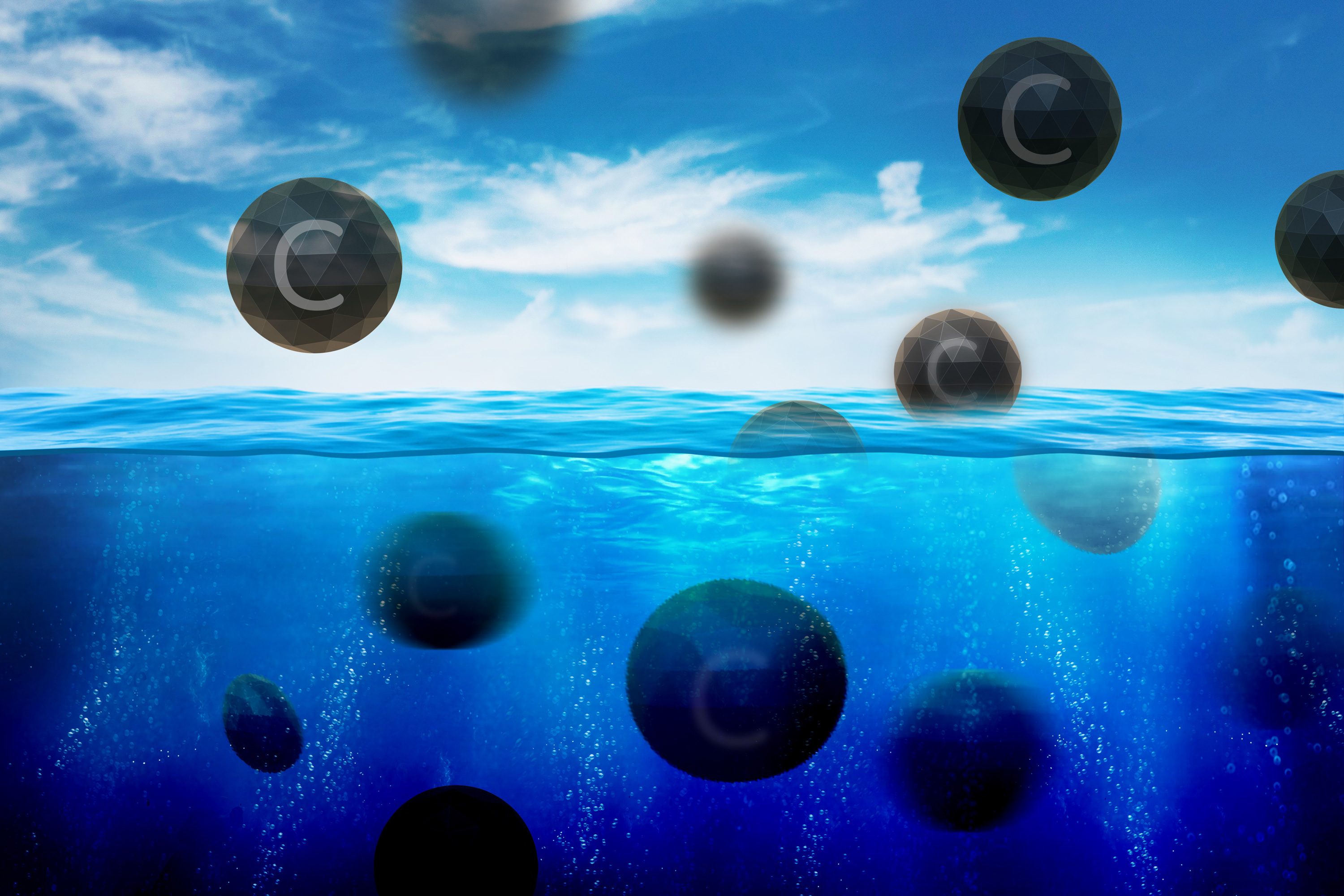
The relationship between ocean and human organism. The Carbon dioxide (CO2)
· Introduction
The ocean covers 71% of the planet’s surface with a huge mass of water that hides the most ancient and fabulous creatures ever exist. But the ocean is not only that. It is a vital sourse of energy, food and health for humanity, no matter how far we are from its shores. Our lives are closely linked to the state of the ocean. Healthy waters and biodiversity can offer critical benefits to all people, such as new medicines, technologies, nutritious and sustainable diets and opportunities to bolster physical and mental wellbeing.
· Carbon dioxide emissions
It is one of the biggest problem in our days, all because of the human activities, like burning fossil fuels in special centrals to create energy for transport, electricity, heat etc. According to NOAA GML (Mauna Loa Observatory), the global level of CO2 from atmosphere has reached to 427ppm in 2026, with 186.5% more than in the pre-industrial era (1850-1900), which had a score of 229ppm. But thanks to the ocean’s power of capturing this gas from the atmosphere through certain natural wonders, the CO2 level is partially stabilized.
From a medical point of view, the researches show that the exposure to environmentally relevant elevations in ambient CO2 (even if it doesn’t feel like it) can cause inflammation, reductions in higher-level cognitive abilities, bone demineralization, kidney calcification, oxidative stress and endothelial dysfunction.
The human cells produce continuously CO2 as a waste product of metabolism. The blood carries it to the lungs, where it is exhaled. This process is tightly linked to the blood’s acid-base balance: CO2 combines with water in blood to form H2CO3, which splits into HCO3 and H2 ions. The body uses this reaction as a buffer system, keeping blood pH in a narrow range. When a human breath air with elevated CO2 level, this system gets pushed off balance, its blood becomes more acidic, and its breathing rate increases as the body tries to compensate.
In addition, the most conspicuous effect of moderately elevated CO2 is what it does to human ability to think, cognitive performance. In a controlled study from Harvard’s T.H. Chan School of Public Health, cognitive function scores decreased 15% when CO2 was around 945 parts per million (ppm) and 50% at approximately 1,400 ppm, compared to well-ventilated conditions. On average, every 400 ppm increase in CO2 was associated with a 21% decrease in cognitive scores across all domains tested.
Everything it has been written up to now sounded awful. But all the numbers and data are kept under control by the ocean wonders. As the fossil fuels are burnt and atmospheric carbon dioxide levels go up, the ocean absorbs more CO2 to stay in balance. It is the planet’s second-largest carbon sink after the Earth’s rocky shell (sedimentary rocks on land and the sea floor) and contains around 40,000 billion tons of carbon, the greatest share of which is dissolved in seawater.
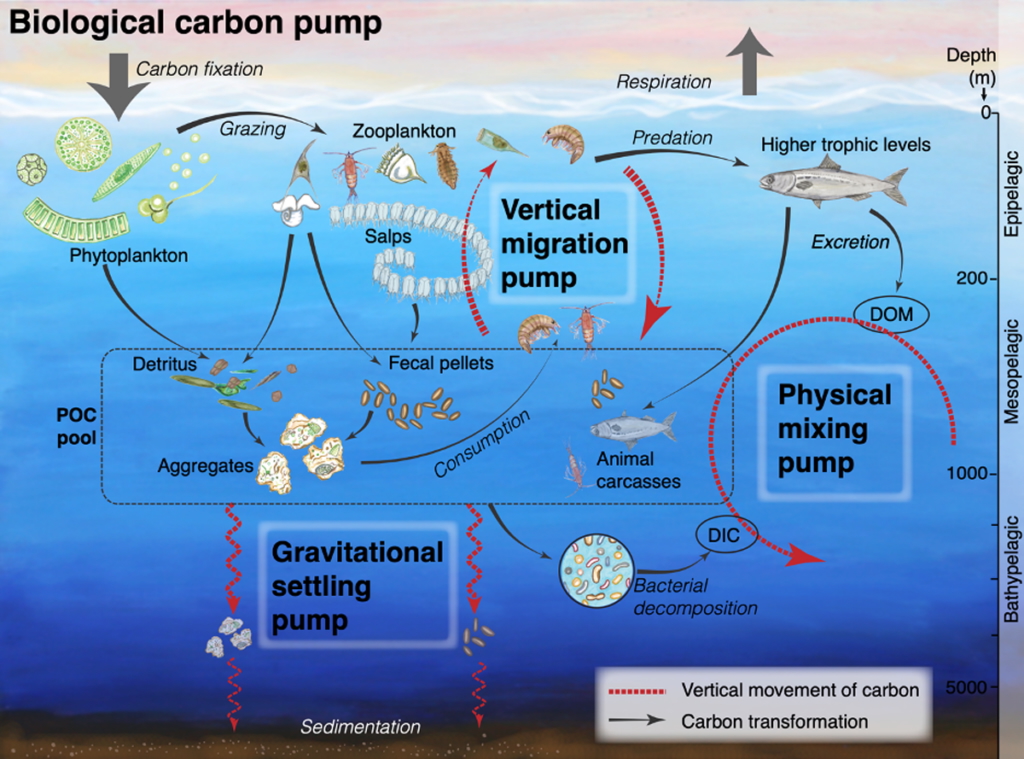
The physical carbon pump process consists in the absorption of the gas by surface waters. However, the water must cool down, because the low temperature is an important factor in the dilution of CO2.The cooled and salty mass of water, full with carbon sinks to the greater depths, as it become denser and heavier. This process is frequent in Arctic and Antarctic regions, where the conditions are favorable for this phenomenon.
The organic biological carbon pump involves more marine plants and animals which absorb carbon dioxide in different ways, helping our planet to survive from human’s negligence:
1. Phytoplankton and the marine food web
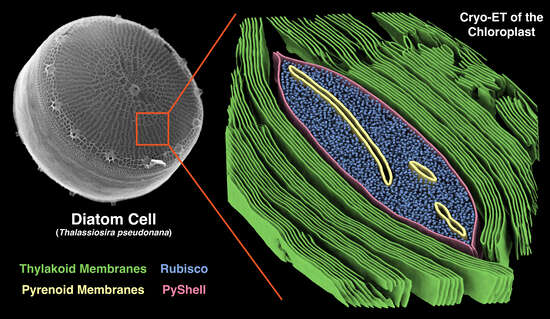
Phytoplankton is a group of organism which drifts with the ocean currents and provides its nutrition by photosynthesis. They are vital for the global carbon cycle, especially diatoms, single celled organisms which store for up to 20% of the Earth’s CO2 gases.
In plants and algae, photosynthesis occurs in chloroplasts where the energy from sunlight is taken by thylakoid membranes and then used to help the enzyme Rubisco to fix CO2. But, algae have an advantage: they store all their Rubisco into small compartments called pyrenoids, where CO2 can be captured more efficiently. “We have now discovered that diatom pyrenoids are encased in a lattice-like protein shell,” says Dr. Manon Demulder, author on two studies about diatoms. “The PyShell not only gives the pyrenoid its shape, but it helps create a high CO2 concentration in this compartment. This enables Rubisco to efficiently fix CO2 from the ocean and convert it into nutrients.”
When it dies, phytoplankton sinks into depths, keeping the carbon isolated from our living space. However, being almost imperceptible by our sight and having a very small mass, it might take two weeks or even months to reach the seafloor. That is why other animals speed up this process.
Phytoplankton is a very important source of food for zooplankton (heterotrophic plankton) and krill (tiny crustaceans). They are eaten by filter-feeders whales and sharks, but also fish, squids, seals or seabirds. The food web continues (for example, the fish and squid are devoured by bigger and ferocious animals and so on) until a living being dies and immerses, faster than phytoplankton, with all the CO2 captured in its bones or hard shell.
Another related phenomenon of carbon sequestration is transporting it by fecal pellets. The CO2 trapped in the animal’s body is excreted and becomes one with the sand of the great depths. The falling particles from death organisms or beings and fecal pellets are known as marine snow.
2. Algae
Algae play a uniquely important role in absorbing carbon dioxide from the atmosphere because of their high photosynthetic efficiency and rapid growth rates. Uptake of CO2 by algae is nearly twice of the weight of them, which is 10–50 times higher than that of absorption technologies (Wilberforce et al., 2019; Gong and You, 2015).
They thrive in a great measure via photosynthesis by converting CO2 and/ or bicarbonate into O2 and carbon-containing products. Algae absorb CO2 primarily through diffusion across their cell membranes. Because algae often live in aquatic or humid environments, dissolved CO₂ or HCO3 ions move easily into the cell, where they are used during photosynthesis. CO2 penetrate into algal cells from the surrounding air or water and pigments, such as chlorophyll, capture light energy, starting the photosynthesis process. Then, with the help of enzymes, the algae transform CO2 into organic carbon compounds. By the time the carbon is fixed, it becomes part of algal biomass, supporting growth and reproduction. Finally, O2 is released as a byproduct of water splitting during the light-dependent reactions.
3. Mangrove forests.
Mangroves are salt-tolerant trees which distribute their weight over a wide area with stilt-like roots or buttress roots that cover the nearby surfaces. They thrive along tidal estuaries, in salt marshes and on muddy saline or brackish coasts.
Their role in carbon capture has a huge global importance. One hectare of mangrove stores approximatively 907 tons of CO2. If it is compared, boreal forests deposit 350 tons of carbon per hectare, temperate forests 340 tons per hectare and mountain tropical forests less than 300 tons per hectare. Like in any other forest, CO2 is absorbed through leaves, consumed and deposited in the growing wood and the remaining oxygen is then released. When they die, the plants sequester the carbon in the low oxygen soil.
· But still: the impact of human disharmony with the ocean
Carbon dioxide is one of the major pollutant released in the atmosphere. Even though the ocean’s waters dissolve the CO2, remaining less greenhouse gas in air, it lowers its pH, making the water more acidic.
In consequence, it reduces the amount of carbonate ions which are truly important for shellfish, like crustaceans and scallops, more precisely for their normal way of protecting themselves. Shells are made out of calcium carbonate (CaCO3) and when carbon, the raw material, is in excess, they are starting to dissolve in water. Sensitive species may lose their armor, thus causing exposure to the dangers of the wilderness or even death.
Another consequence of the ocean acidification is seen on larvae. Having complex lifecycles, many fish and invertebrates in larvae stages will not develop properly when acidity is increased. They also lose their ability to smell, being not capable anymore to avoid predators. These living beings have less chance of reaching sexual maturity for reproduction.
· Conclusion
As global carbon emissions continue to rise, biological carbon absorption processes are gaining renewed attention. Both human organism and the ocean are affected by a gas which we are producing by different uncontrolled and immoderate activities. The immense mass of water that surrounds and animates the Earth is already involved in saving the planet through various mechanisms, both physical and biological. However, the ocean cannot withstand change or fight alone, because it begins to slowly destroy itself, through acidification or changing temperatures, which brings dramatic consequences to the entire marine ecosystem. The sea helps the human beings, so people need to help it too, forasmuch if the ocean dies, we will die likewise. Human body is tight connected with the state of the Earth, providing us breathable air, food and freedom. How can people start protecting the Blue planet? By reducing CO2 in the air, minimizing the effort made by ocean to adapt to new unfavorable conditions.
· References
Carbon Dioxide Effects on Humans and the Environment - ScienceInsights
Carbon Dioxide Effects on Humans and the Environment - ScienceInsights
https://carbelim.io/how-algae-absorb-carbon-dioxide-through-photosynthesis/
Stay Informed
Join our community of medical professionals and researchers. Get the latest insights delivered to your inbox.